


Industrial and PoE+ Switches for Harsh UAE Sites: Fanless, DIN-Rail and Temperature Range

An industrial switch is not a faster switch. It is the same switching function built to survive where a commercial one will not: no fan, a much wider operating temperature range, DIN-rail mounting, dual DC power inputs and better surge protection. In a UAE plant room, roadside cabinet or unconditioned warehouse, those are the properties that determine whether the network stays up through August.
The short answer
- Fanless is the point. Fans are the first thing to fail in dust and heat.
- Check the temperature range against the cabinet, not the weather. An enclosure in sun runs far hotter than ambient.
- PoE budget is a total, not a per-port figure — and it is where most sizing errors happen.
- Dual DC inputs give real redundancy that a single mains adapter cannot.
- Surge protection matters on anything with an outdoor cable run.
What makes a switch industrial
Fanless, convection-cooled design
A commercial switch uses a fan. Fans draw dust through the chassis, have bearings that wear, and are the most common single point of failure in a dirty environment. Industrial switches dissipate heat through a finned metal case instead, with no moving parts at all.
The trade is that the case runs hot to the touch and needs airflow around it, so cramming three into a sealed enclosure with no ventilation defeats the design.
Extended temperature range
Commercial switches are typically rated to around 45°C ambient. Industrial models commonly cover something like -40°C to +75°C, with the exact range varying by product.
The number that matters is the temperature inside the enclosure, not the outdoor shade temperature. A sealed steel cabinet in direct Gulf sun can run considerably above ambient, and the equipment inside adds its own heat. If the cabinet is outdoors or in an unconditioned plant room, measure it across a day in summer before selecting on specification.
DIN-rail mounting
Industrial switches clip onto a standard DIN rail alongside breakers, power supplies and controllers, rather than needing a rack. In a control cabinet this is what makes the installation tidy and serviceable.
Redundant DC power input
Most industrial switches accept a DC supply, usually over a range such as 12–48V, through two independent input pairs. Feed them from two separate supplies and the switch survives the loss of either. That is genuine redundancy, and it is available at a price a redundant-PSU rack switch could not match.
Surge and transient protection
Ethernet cable running outdoors, between buildings or alongside power cable picks up transients. Industrial switches generally include better surge immunity on ports and power inputs. For runs leaving a building, add external surge arrestors as well — the switch's internal protection is a second line of defence, not a substitute.
Ring redundancy
Managed industrial switches typically support fast ring recovery protocols, so a cable break in a ring topology heals in milliseconds rather than the seconds a standard spanning-tree implementation takes. For process control and video, that difference is the difference between a glitch and an outage.
Getting PoE right
This is where most specifications go wrong, and it is arithmetic rather than judgement.
The three PoE standards
- 802.3af (PoE) — up to about 15.4W at the switch port. Suits basic fixed cameras, access points and IP phones.
- 802.3at (PoE+) — up to about 30W. Suits PTZ cameras, cameras with heaters, and higher-power access points.
- 802.3bt (PoE++) — up to about 60W or 90W depending on type. Suits heated outdoor PTZ domes, displays and powered devices.
Budget, not ports
A switch's PoE budget is the total power it can deliver across all ports simultaneously. An eight-port switch advertised as PoE+ does not necessarily supply 30W on all eight ports at once, because its total budget may be well below 240W.
Size it properly: add the real draw of every device, add headroom for cable loss on long runs, and add margin for the devices that draw more in cold starts or when heaters and IR illuminators run at night. Cameras draw their peak at night, which is exactly when nobody is watching the switch.
Our guide to how many cameras one PoE switch can power works through the arithmetic in detail.
Distance
Standard ethernet runs to about 100 metres. Beyond that, use fibre with a media converter or a switch with fibre uplinks, or an extender where fibre is impractical. On industrial sites the distances usually argue for fibre uplinks between cabinets and copper only for the final drop.
Where these switches belong in the UAE
- Plant rooms and pump houses — hot, dusty, no air conditioning.
- Roadside and perimeter cabinets for CCTV, ANPR and barriers — solar load, long cable runs, power quality issues.
- Warehouses and logistics yards — dust, vibration, wide temperature swing between shaded and sunlit areas.
- Construction site offices and temporary compounds — unstable power, frequent relocation.
- Car park levels — unconditioned, humid, dusty, usually full of cameras.
- Manufacturing floors — electrical noise, vibration, and a strong preference for DIN-rail everything.
An ordinary office switch in a comms room with air conditioning does not need any of this, and paying for it there is waste. The question is simply whether the environment is controlled.
Managed or unmanaged?
Unmanaged industrial switches are cheaper and need no configuration, which suits a simple edge cabinet with a handful of cameras.
Managed switches add VLANs, ring redundancy, port monitoring, PoE control per port and remote diagnostics. The feature that earns its keep most often is remote PoE port cycling: a frozen camera can be power-cycled from the office rather than by driving to the site. On a dispersed installation that single capability pays for the upgrade.
Specification checklist
- Measured enclosure temperature in summer, not ambient.
- Total PoE budget against the summed real draw of connected devices, with night-time peaks included.
- PoE standard per port matched to the device that will plug into it.
- Power input — DC with dual inputs where redundancy matters, and the supply to feed it.
- Uplink type — fibre for anything over 100 metres or between buildings.
- Surge protection internal and external for outdoor runs.
- Mounting — DIN rail, wall or rack, and the space available.
- Ingress protection of the enclosure the switch will live in.
Where this connects to the rest of the site, see our guides to CCTV storage and camera sizing and UPS and power protection.
Frequently asked questions
What is an industrial network switch?
An industrial switch performs the same function as a commercial one but is built for uncontrolled environments: fanless convection cooling, a much wider operating temperature range, DIN-rail mounting, dual DC power inputs for redundancy, and stronger surge and vibration immunity.
Do I need an industrial switch or will an office switch do?
If the switch lives in an air-conditioned comms room, an office switch is appropriate and an industrial one is wasted money. If it lives in a plant room, roadside cabinet, warehouse, car park level or site compound, the environment rather than the bandwidth should decide, and an industrial switch is the correct choice.
What is the difference between PoE, PoE+ and PoE++?
802.3af (PoE) delivers up to about 15.4W per port, suiting basic cameras and access points. 802.3at (PoE+) delivers up to about 30W, suiting PTZ cameras and cameras with heaters. 802.3bt (PoE++) delivers up to about 60W or 90W depending on type, for heated outdoor domes and higher-power devices.
How do I size a PoE switch?
Size against the switch's total PoE budget, not its port count. Add the real draw of every connected device, allow for loss on long cable runs, and include night-time peaks when camera heaters and infrared illuminators run. A switch advertised as PoE+ may not deliver full power on every port simultaneously.
How hot does a switch cabinet get in the UAE?
Considerably hotter than the shade temperature outside. A sealed steel enclosure in direct sun gains heat from solar load and from the equipment inside it. Measure the internal temperature across a summer day before selecting equipment, rather than specifying against ambient.
Should I choose a managed or unmanaged industrial switch?
Unmanaged suits a simple edge cabinet with a few devices. Managed adds VLANs, fast ring redundancy, monitoring and per-port PoE control — and the ability to power-cycle a frozen camera remotely, which on a dispersed site usually justifies the cost difference by itself.
Specifying networking with Procure
We supply networking equipment across the UAE alongside the cameras, access control and power protection that connect to it. Tell us where the switch will physically sit, what plugs into it and how far the cable runs, and we will size the temperature rating and the PoE budget against the site rather than the catalogue.
More insights
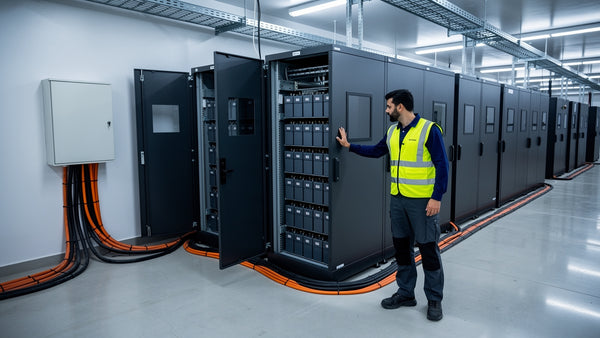
What Size UPS Do I Need? Direct Answers by Load and Runtime
Add up the watts, add 25 per cent, divide by 0.9 to get VA. That is the whole calculation. Here...
Legacy Desktops, Workstations and Monitors: The Model Index
EliteDesk 800 G6 SFF, ThinkStation P900, Z24nf, E240c. Business hardware codes carry tier, generation and form factor in a fixed...

The Fluke Model Index for UAE Maintenance Teams
6500-2, 62 MAX+, TiX580, 1587 FC. Fluke numbers identify a family, not a spec — the meaning is in the...


